Knowledge Path · 5 books
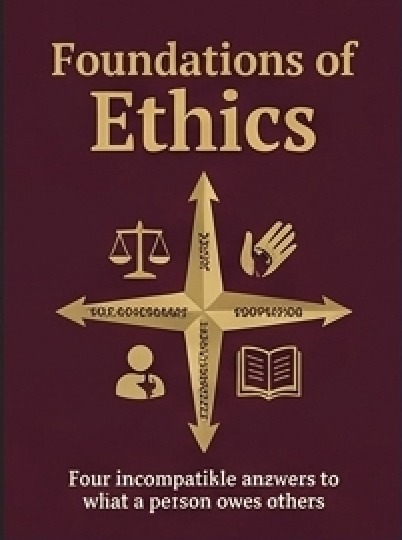
Foundations of Ethics
Epictetus limits what you owe to what you control; Machiavelli treats other people's outcomes as material; Aristotle makes virtue a habit inside a community; Mill sums consequences; Kant says consequences are irrelevant. Where this leaves you: whether morality is something you cultivate, calculate, or are bound by.
What you'll understandWhat do I owe people whose outcomes I control?
Discover
Free previewEnchiridion

Epictetus: you owe others nothing that depends on controlling them; the only thing in your power is your own response. Question: What does Epictetus say you're responsible for when someone else is harmed?
Understand
The Prince
Machiavelli answers with whatever preserves your position — other people's outcomes as your material rather than your concern. (Genuine Prince recordings exist ~3h16–5h54; the page's recommended slot is still a Hamlet misfile.) Question: Is Machiavelli immoral, or working from a different question than Epictetus?
Included with a free account
Connect
Nicomachean Ethics
Aristotle rejects both frames: virtue is a settled disposition formed by habit inside a community you can't opt out of. Question: Which of the first two would Aristotle call a failure of character rather than of reasoning?
Included with a free account
Go Deeper
Utilitarianism
Mill abandons character for arithmetic: the right act is the one with the best consequences summed across everyone affected. Question: What does Mill's calculation require you to know that you can't?
Included with a free account
Complete the Path
Fundamental Principles of the Metaphysic of Morals
Kant: consequences are irrelevant to whether an act is right — obligation grounded in a form of reasoning that owes nothing to habit, position, or outcome. Question: Where does Kant's rule give a different answer than Mill's arithmetic on the same case?
Included with a free account