Knowledge Path · 5 books
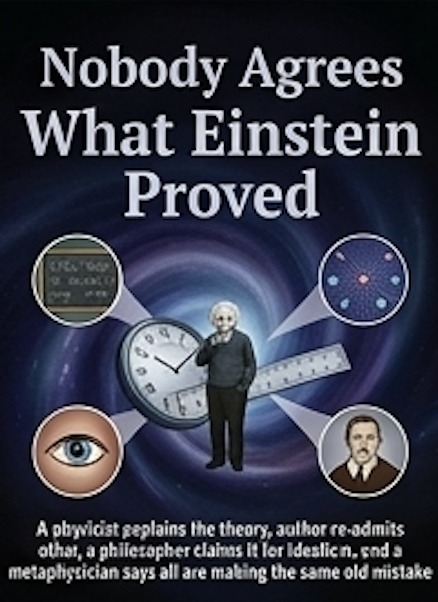
Nobody Agrees What Einstein Proved
A physicist explains the theory, its author quietly re-admits an ether, a philosopher claims it for idealism, and a metaphysician says all of them are still making the same old mistake. Where this leaves you: whether a physical theory can settle a philosophical question, or only relocate it.
What you'll understandWhen two people disagree about what happened, is one of them wrong?
Discover
Free previewThe Einstein theory of relativity
Lorentz's period popularization walks you through the theory in an hour without math — cheapest entry, takes nothing for granted. Question: What is Lorentz conceding, and what is he not?
Understand
Sidelights on relativity
Einstein's 1920–21 lectures: the first reinstates a kind of ether; the second asks whether geometry is discovered or stipulated. Complicates rung 1's tidy "the ether is gone." Question: If the ether comes back, what exactly did the theory kill?
Included with AudioShelf Plus
Connect
Relativity: The Special and General Theory
Einstein's primary source for non-specialists — what the theory actually asserts rather than what it implies. Question: Where does Einstein refuse to draw the philosophical conclusion everyone else draws?
Included with AudioShelf Plus
Go Deeper
The general principle of relativity in its philosophical and historical aspect
Carr annexes relativity for idealism: the observer isn't incidental to nature, he's constitutive of it. Rung 3 gives him no such license. Question: Is Carr reading the theory or using it?
Included with AudioShelf Plus
Complete the Path
Science and the Modern World
Whitehead rejects the whole frame — the split between nature-as-measured and nature-as-experienced was the error, and relativity exposes it rather than solving it. Question: What does Whitehead say the last three books have in common?
Included with AudioShelf Plus