Knowledge Path · 5 books
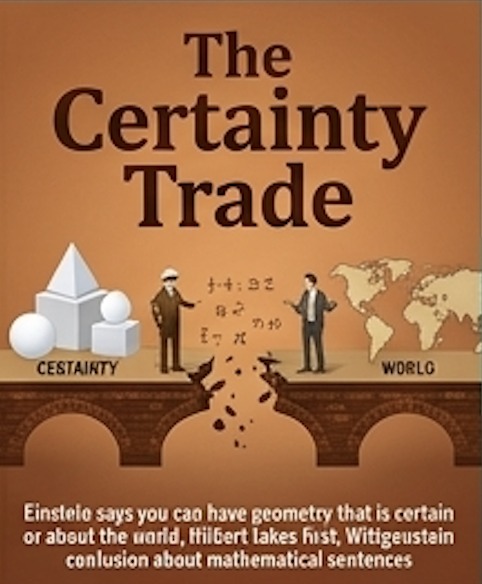
The Certainty Trade
Einstein says you can have a geometry that is certain or one that is about the world, not both. Hilbert takes the first horn and builds an empire on it; Wittgenstein says the whole trade was a confusion about what mathematical sentences do. Where this leaves you: if mathematics asserts nothing, Einstein's dilemma dissolves — and so does any account of why Hilbert's axioms describe the space you walk through.
What you'll understandWhen a mathematical statement is true, what is it true of?
Discover
Free previewSidelights on relativity

Einstein's "Geometry and Experience": as far as mathematics is certain it says nothing about reality, and as far as it says something about reality it isn't certain. Question: Which horn does he actually take?
Understand
Flatland
Abbott's Square is certain his geometry is necessary; the certainty turns out to be a report on his confinement. Question: What does the Square know after the Sphere leaves that he couldn't have reasoned to?
Included with AudioShelf Plus
Connect
The ABC of atoms
Russell on the atom: a domain where no picture works and the equations are the only access — the analogy method runs out before the physics does. Question: Where does Russell say the picture fails, and what replaces it?
Included with AudioShelf Plus
Go Deeper
The foundations of geometry
Hilbert: points, lines and planes are whatever satisfies the axioms; the standard is consistency, not truth about anything. Question: What work is independence doing that consistency isn't?
Included with AudioShelf Plus
Complete the Path
Tractatus Logico-Philosophicus
Wittgenstein: mathematical propositions are equations; they say nothing, and logic is tautology. Question: If the propositions say nothing, why does the method work?
Included with AudioShelf Plus