Knowledge Path · 5 books
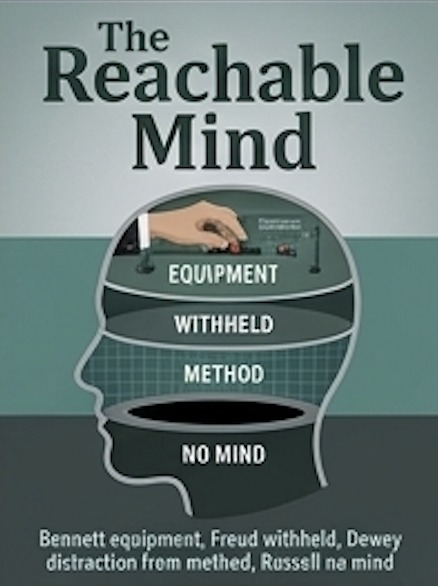
The Reachable Mind
Bennett says your mind is equipment you operate. Freud says the part that decides is deliberately withheld from you. Dewey says the whole question of inner access is a distraction from method. Russell says there is no mind there to reach. Where this leaves you: every rung claims a different thing is the real evidence about a person — report, symptom, test, behavior, or extreme experience — and none of them can be checked by the others' method.
What you'll understandHow much of what goes on in a person is available to that person?
Discover
Free previewSelf and self-management

Bennett: your mental life is apparatus you own, and failure to run it well is mismanagement, not fate — the assumption everything after attacks. Question: What does Bennett assume you can see when you look at yourself?
Understand
Dream Psychology
Freud's short 1920 popularization: the material that governs conduct is kept out of reach on purpose, reachable only sideways through dreams and errors. Question: What counts as evidence for Freud, given that the subject can't confirm it?
Included with AudioShelf Plus
Connect
How we think
Dewey: thinking isn't a private possession — it's a public operation that begins in a difficulty and ends in a test. Question: Where does Dewey put the thing Freud put inside the person?
Included with AudioShelf Plus
Go Deeper
The analysis of mind
Russell: there is no mind as a substance; "mental" and "physical" are two orderings of the same neutral material. Question: After Russell, what is left of the word "introspection"?
Included with AudioShelf Plus
Complete the Path
The Varieties of Religious Experience
James treats conversion, mysticism, and the divided self as evidence arriving through a margin no procedure reaches — reopening what Russell closed. Question: Which of James's cases can Russell's scheme not restate?
Included with AudioShelf Plus