Knowledge Path · 6 books
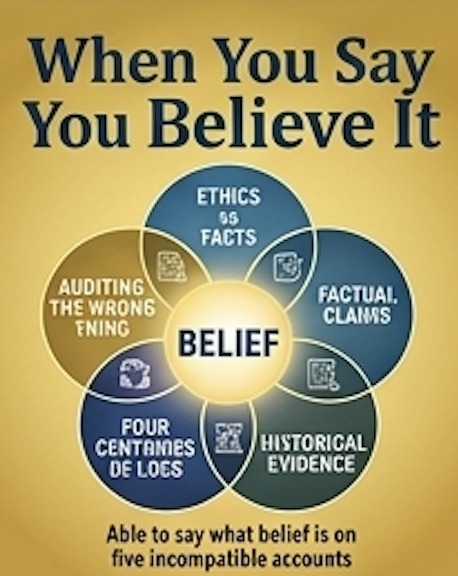
When You Say You Believe It
Russell and Machen agree that a religion's ethics can't outlive its factual claims, and split on which half to throw away. Feuerbach says the claims were never about God in the first place. Glover says they're recoverable by ordinary historical work. White says they've been losing ground for four centuries. James says all five are auditing the wrong thing. Where this leaves you: able to say what belief is on five incompatible accounts — and unable to say which account gets to arbitrate between them.
What you'll understandWhen someone holds a religious belief, what are they holding — and what could change it?
Discover
Free previewWhat I Believe

Russell's short creed: hold beliefs on evidence, treat religion as the residue of fear, build the good life from love and knowledge. (Prefer the Russell recording, not the Tolstoy title-merge on the page.) Question: What does Russell assume survives when the doctrines go?
Understand
Christianity and Liberalism
Machen agrees you can't keep the ethics and drop the events, then reverses the verdict: a religion reduced to moral disposition is a different religion. Question: Where exactly does Machen locate the thing that can't be given up?
Included with AudioShelf Plus
Connect
The Jesus of history
Glover refuses both prior rungs by reconstructing a person from evidence and resting belief on that reconstruction. Question: Is Glover's Jesus recovered from the sources, or read into them?
Included with AudioShelf Plus
Go Deeper
Essence of Christianity
Feuerbach: the predicates of God are the predicates of the human species — theology is true as anthropology. Question: If Feuerbach is right, what is left for Machen to defend?
Included with AudioShelf Plus
Go Deeper
A history of the warfare of science with theology in Christendom
White turns Machen's premise into a ledger: wherever theology made a factual claim, it eventually conceded. (Indexed recording is Volume Two.) Question: Is this a record of defeat, or of a claim being relocated?
Included with AudioShelf Plus
Complete the Path
The Varieties of Religious Experience
James throws out the shared assumption that belief is settled by what it asserts — takes the states themselves as data and judges them by what they produce in a life. Question: Does James's test let anything be false?
Included with AudioShelf Plus